
25 février 2026
Avoiding foods labeled with Health Canada’s new front-of-package symbol could reduce the risk of heart disease
A new Université Laval study concludes that the front-of-package nutrition symbol now required by Heath Canada on foods with excessive salt, sugar, or saturated fat is a promising tool for improving nutrition and reducing the risk of heart disease.

'%3e%3cpath%20d='M306.615%2079.694H144.011L892.476%201150.3h162.604ZM0%200h357.328l309.814%20450.883L1055.03%200h105.86L714.15%20519.295%201200%201226.37H842.672L515.493%20750.215%20105.866%201226.37H0l468.485-544.568Z'/%3e%3c/g%3e%3c/svg%3e)


A new Université Laval study concludes that the front-of-package nutrition symbol now required by Heath Canada on foods with excessive salt, sugar, or saturated fat is a promising tool for improving nutrition and reducing the risk of heart disease.
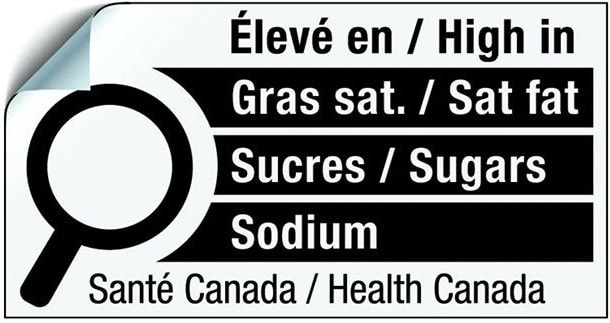
In the study recently published in The American Journal of Clinical Nutrition, scientists showed that reducing by just 10% the consumption of foods labeled with the symbol, a black and white magnifying glass, was beneficial. “If your grocery cart contains 10 products with the symbol, replacing just one of them with an equivalent product without the magnifying glass could provide long-term health benefits,” explains the study's lead author, Jean-Philippe Drouin-Chartier, professor at Université Laval’s Faculty of Pharmacy and affiliated researcher at the Institute of Nutrition and Functional Foods’ NUTRISS Centre.
Since Heath Canada’s front-of-package labeling only became mandatory in January 2026, the research team was unable to directly measure its effects. Instead, they simulated what a 10% reduction in consumption of foods currently labeled with the symbol would look like. To achieve this, the scientists analyzed data from 2,123 Quebecers in the CARTaGENE cohort with cholesterol or blood pressure problems whose diets were evaluated in 2011. Of the 285 foods considered at the time, 99 would now be labeled with the magnifying glass symbol: 57% were too salty, 42% too fatty, and 30% too sweet. Some foods fell into more than one category.
By comparing the proportion of these problematic foods in the diets of people in the cohort, the team observed that those who consumed the least amount of them were at the lowest risk of developing cardiovascular disease. The results suggest that a 10% reduction made a difference, regardless of the initial level of consumption, reports Professor Drouin-Chartier.
The research team also showed that a change in diet, combined with taking prescription medication for cholesterol or blood pressure, provided optimal protection. The two approaches are complementary. “A medication will target a single thing, such as cholesterol. Reducing consumption of foods with the magnifying glass symbol may improve cholesterol, blood pressure, and blood sugar levels, all of which are risk factors for cardiovascular disease,” explains the researcher.
In addition to foods labeled with the magnifying glass symbol, the study took a broader look at ultra-processed foods. The researchers found that a 10% reduction in the consumption of ultra-processed foods was associated with similar heart health benefits as an equivalent reduction in foods labeled with the front-of-package symbol. “There is some overlap, as many ultra-processed foods are high in fat, salt, or sugar, but the magnifying glass, while simple and effective, has blind spots,” says Professor Drouin-Chartier. That’s the case with diet soft drinks, in which sugar has been replaced by sweeteners. “Because of the magnifying glass, people who used to drink regular soft drinks may switch to diet drinks, but we have to ask ourselves whether this is an optimal substitution,” he says.
The study's authors are Lise Leblay, Jacob Lessard-Lord, Neha Khandpur, Jean-Sébastien Paquette, and Jean-Philippe Drouin-Chartier.
Source:
ULaval communications
Université Laval
Download images