
27 avril 2026
Carney Polimeter: Tracking 440 Liberal election promises
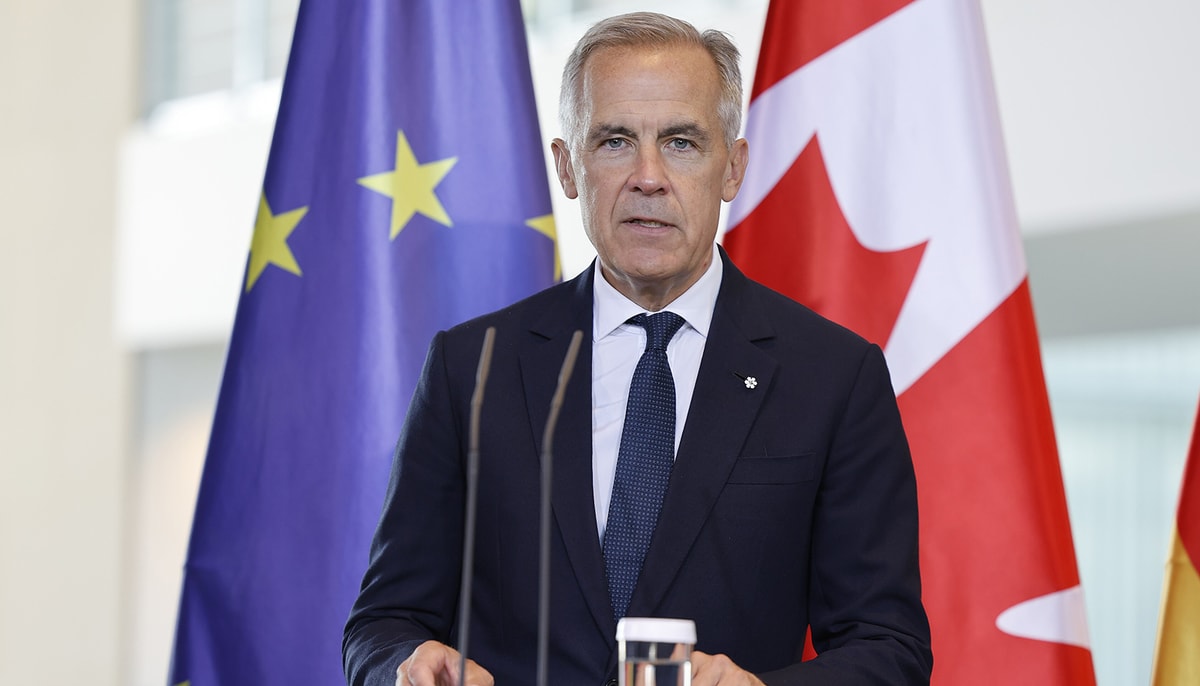
One year since the last federal election and on the eve of his first economic statement with a majority government, Mark Carney’s Liberal government has fulfilled, in whole or in part, 9% of the promises made during the spring 2025 election campaign: 6% (28 promises) of the Liberal Party’s campaign pledges have been fully fulfilled, 3% (14 promises) have been partially fulfilled, and 26% (113 promises) are currently being implemented.

'%3e%3cpath%20d='M306.615%2079.694H144.011L892.476%201150.3h162.604ZM0%200h357.328l309.814%20450.883L1055.03%200h105.86L714.15%20519.295%201200%201226.37H842.672L515.493%20750.215%20105.866%201226.37H0l468.485-544.568Z'/%3e%3c/g%3e%3c/svg%3e)


— Dr Frank Gaeth Wikimedia
The majority (62% or 273 promises) of the 440 promises made by Mark Carney and his team remain pending, while 3% (12 promises) are broken. These are the preliminary findings of the Polimeter team, which has been tracking and publishing the status of election promises made by various governments in Canada since 2013.
In response to the economic and political threats made by President Trump, Mark Carney’s Liberals announced 118 promises (27%) aimed at expanding domestic trade in Canada and stimulating the economy through major civil infrastructure and national defence projects. The Carney government also prioritized the environment and energy (54 promises, 12%), emphasizing the idea that Canada must become an energy superpower, as well as pledges about international affairs and defence (52 promises, 12%). These promises are primarily aimed at reducing Canada’s dependence on the United States.
“The Carney government acted swiftly on key promises regarding Canada’s economic, political, and international security,” explains Lisa Birch, co-founder and director of Polimeter, who is also a researcher at the Centre for Public Policy Analysis (CAPP) at Université Laval. “The number of pending pledges after one year varies from government to government and tends to be higher in times of crisis, difficult economic conditions, and minority status without a stability agreement. We anticipate that Carney’s new majority status will lead to action on pending pledges,” she adds.
“The fact that the government was, until very recently, a minority government made it harder to fulfill campaign promises,” notes Benjamin Carignan, a data scientist on the Polimeter team. “For example, the Carney government had to withdraw Bill C-2, which would have allowed law enforcement to search packages and letters for narcotics. Opposition parties and various experts were concerned about infringements on privacy rights and civil liberties. The government withdrew this bill, thereby breaking an election promise. On the other hand, the context of significant economic, political, and international uncertainty facilitated the passage of laws and measures central to Carney’s vision of a strong Canada, notably Bill C-5, the Building Canada Act, which completed the legislative process in just 20 days!”
“Once again, we see a Liberal government that has made a lot of promises,” notes Alexandre Fortier-Chouinard, a data scientist and postdoctoral researcher at CAPP. “Since the first Trudeau government in 2015, Canadian governments have made at least 340 promises per election campaign. We are now at 440. Even though the promises made by the Liberals under Mark Carney differ from those made by the Liberals under Justin Trudeau, the number of promises remains far greater than under the Chrétien, Martin, and Harper governments, which made between 50 and 200 promises per campaign.”
The Polimeter web application is built by the Digital Society Lab at McMaster University and Vox Pop Labs. The Polimeter team, associated with the Center for the Analysis of Public Policy at Université Laval, conducts the research behind the Canadian and Quebec promise trackers.
“Accountability is a cornerstone of representative democracy. Polimeter provides citizens with an independent, evidence-based way to assess how well governments keep their promises,” says John McAndrews, managing director of the Digital Society Lab.
Polimeter is available at https://polimeter.org
French: https://polimeter.org/fr
The Polimeter is supported by research funded by the Social Sciences and Humanities Research Council and the Fonds de recherche du Québec--Société et culture.